

How To Merge Tracks In Garageband
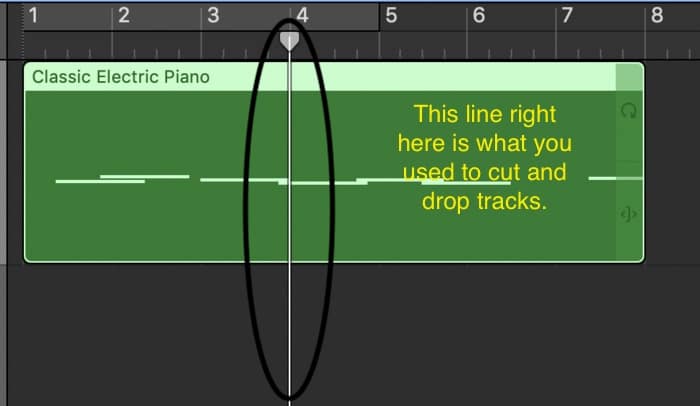
Cutting and editing music in Garageband is as simple every bit using the (Control + T) choice on your keyboard.
For instance, you line up the "Ruler," to the point you lot want to isolate, so use the (Command + T) office. Y'all can exercise this in two dissever areas of your workspace, in the "Piano Roll Filigree," or in the regular workspace.
One tin can as well edit the music using the Marquee line inside the "Piano Curlicue Grid." For example, when yous zoom in on the sound file, y'all tin can highlight the part of it you want to eliminate downwards to the tiniest detail.
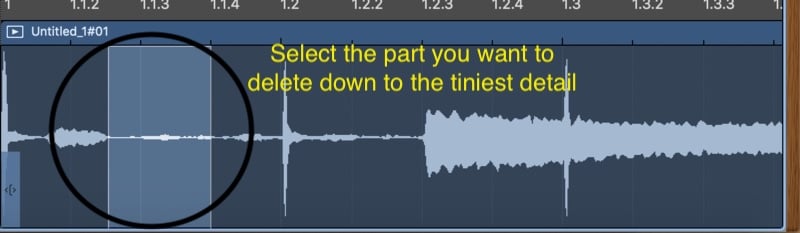
You simply highlight it by hovering the '+' sign over the Audio Region, clicking and dragging over the part you desire to delete then hit the "delete" push button your keyboard. This comes in handy for audio rather than MIDI recordings.
However, you have to make sure that yous're isolating simply ane track, whether it be a sample, an audio recording, or a software instrument track, etc. You can't cut and edit more than than one piece of music at once. It has to be just one.
By the way, I'm always on the sentinel for deals in the music industry (at that place'south usually something if you know where to look). Right now, there are three deals that stick out to me
| Singorama – The Consummate Guide to Singing Like A Professional | |
| MasterClass – Timbaland, deadmau5, Tom Morello, Questlove, Ringo Starr, Metallica, Nas, and Usher | 2-for-ane [Buy 1 Become i Gratis] |
| Punkademic's [Beginner to Avant-garde] Music Theory Class | $nineteen.99 Per Month [Employ the coupon code: "producersociety" for xx% Off] |
How To Disengage the Previous Command (Command + Z)
In case you make a mistake, yous tin always striking the (Control + Z) function to become back to where you were before.
As I've explained in my 12 things yous should know near Garageband article, one of the groovy things near Garageband is that all of the commands used for mean solar day-to-24-hour interval employ on the computer are transferable to the software. It's all fairly intuitive.
Many of the commands that yous've grown accustomed to every bit a Mac user are all the aforementioned functions for Garageband.
Use Melodyne 5 As An Editing Tool for Vocals and Instruments
My comprehensive tutorial on Melodyne 5 explains everything this amazing plug-in can exercise. Celemony'southward Melodyne 5, from Plugin Boutique, is an editing tool that allows y'all to spot right song recording errors and other mistakes that are made during the recording procedure.
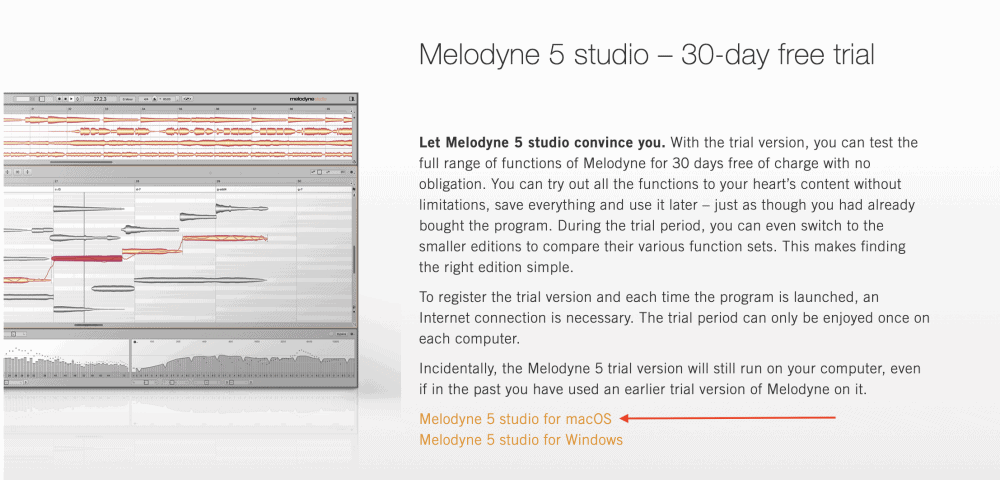
You tin use this to practise things that you would never be able to do with Garageband's default pitch correction tool, includng spot-correcting errors, converting tracks to MIDI, and the listing goes on and on.
How To Zoom In And Out (Command + Left and Right Arrow Key)
Yous can zoom in and out on your MIDI region to see the audio file in more detail by separating your fingers or moving them closer together.
This is particularly useful for when you're trying to edit minute details, that you otherwise wouldn't be able to see and thus, isolate.
You can also zoom in and out through the (Command – Left or Right arrow key).
Merging Tracks Together (Command + J)
Another incredibly useful editing tool in Garageband is the (Control + J) function, which allows the user to substantially combine or merge the tracks together.
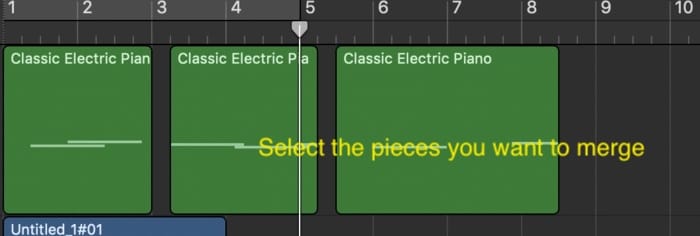
This stops the user from having to re-create and paste every little private runway. Instead, one can just merge all of the music together as 1 track, and so put it on a loop.
To practise this, just select the two or more regions you want to combine and striking the (Command + J) role and it volition all come together.
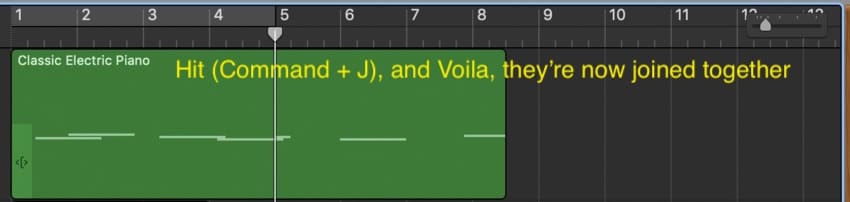
It'due south a great way of saving time and energy during the editing procedure.
Using The Cycle Area For Editing
The cycle area on top of the workspace in Garageband is used for repeating the aforementioned bar of a recording over and over once again. There are a few purposes for this, including practicing a part just before recording, multiple takes, and editing.
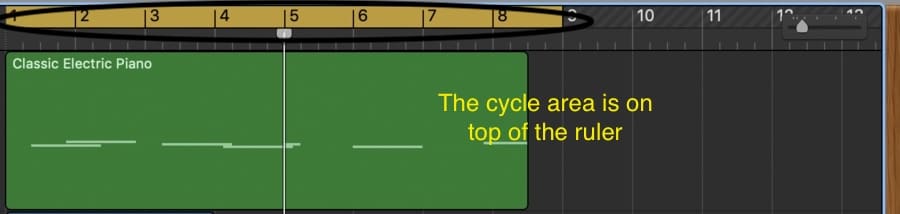
For case, a user can loop the same part repeatedly to guess whether the proper changes have been made during editing.
In other words, if y'all've recorded vocals (using my guide), and forgot the lyrics during ane part and said "um," or something like that, you can loop the same part over and again, and figure out what needs to be eliminated down to the last millisecond, without having to press "Play" repeatedly.
You know that Cycle Fashion is on when it'due south displayed equally a yellow trip in the top portion of the ruler. When it'due south turned off, information technology'due south no longer yellow.
There are two means of turning it on and off:
You can press the Cycle push button within the control bar, or simply printing 'C' on your keyboard.
Changing at what bespeak Cycle Manner starts and stops:
Select the top office of the ruler, so drag your cursor to the desired starting and stopping part of the recording.
How to Edit Using The Re-Size Pointer (Trimming)
Some other way of editing the music is through the "Resize Arrow," which is at the end of every piece of the "effect," every bit Garageband'due south "Quick Help" section calls it.
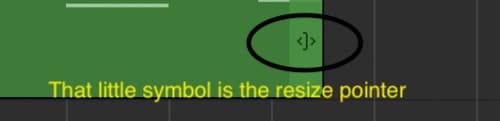
Have the cursor and grab your recording, moving it from side to side, left to right. Using the "Snap To Grid" setting/function allows for the music to literally "snap" dorsum to the line, and thus, stays more than in time.
Snap to Grid Function (Command + G)
Information technology's a lot easier to edit music in Garageband when you have this option selected inside the "Edit" carte on the toolbar on pinnacle. You can plow this function on and off, by striking the (Command + G) office.
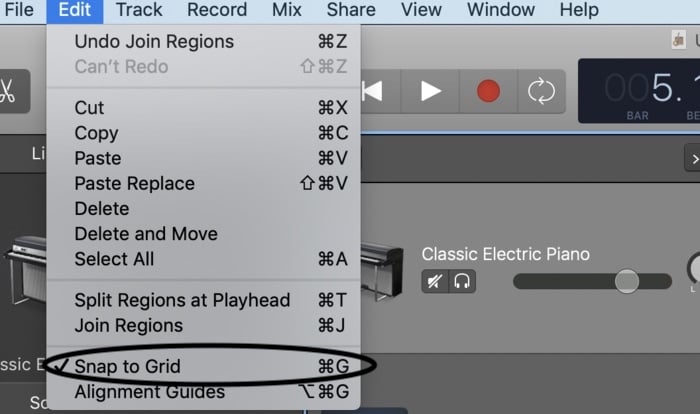
Substantially, every bit I mentioned in a higher place, what this does is information technology literally "snaps" the music right back to the lines on the grid, that way whenever you edit a piece of music, it falls dorsum exactly on the beat out.
If you want, you tin turn this part off and see how hard information technology is to edit music in Garageband. Information technology becomes super annoying, nevertheless, in that location are moments where it's worth your while to plow it off.
How To Copy and Paste in Garageband (Command + C and Command + V)
Once yous've isolated the office you desire, hit the (Command + C) function to copy it, so the (Control + V) function to paste as many copies of it that you lot desire.
Usually, after I've created a melody with the Steinway Grand Piano and PianoForAll as an accessory (their website), I'll open upwards a new "Software Instrument" track, and then copy and paste the music into a different instrument track.
This function allows you to fill up out your mix, without coming up with an entirely unlike musical section. In many cases, you can create an entirely different slice of music, just by copy/pasting it onto a new Instrument rail.
Another Way Of Copying And Pasting an Musical instrument Rails
1) Select the Audio file yous want to copy.
2) Concur downwards the "Option" key.
3) Drag the cursor to the left or right
4) While belongings down the "Pick" key, release the mouse and voila, you've only copied and pasted a new MIDI region.
Of import Things To Note When Chopping Music
Whenever y'all desire to isolate an audio recording, information technology's worth noting that information technology may be helpful to understand at what beats-per-minute the song is, that way you tin can trim music at a specific beat.
This is particularly important when creating music with samples which I've explained how to practice earlier.
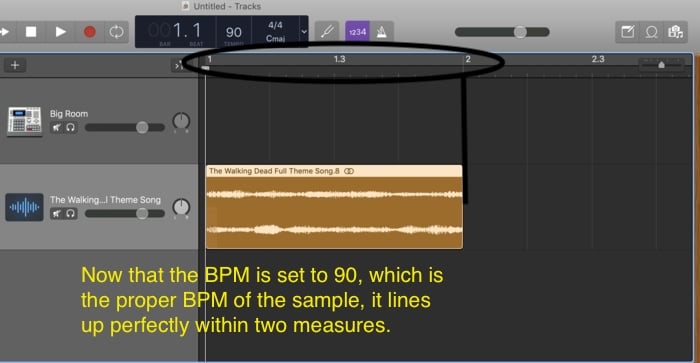
For instance, in a rail that I made using the theme vocal written by Conduct McCreary for The Walking Dead, I had to figure out the BPM of the track, that mode I could make a unlike pulsate track for information technology.
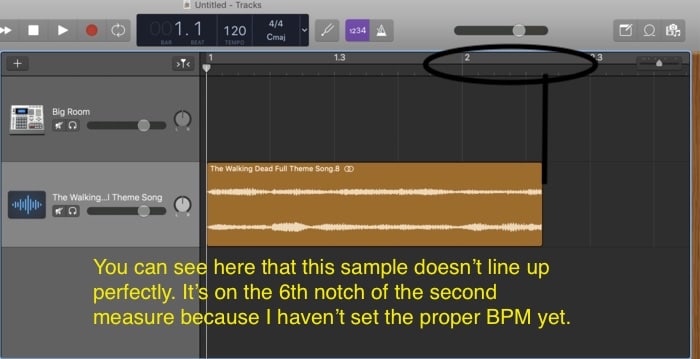
If y'all don't have the proper BPM set up, it'll be almost impossible to make drums for the song, because nada will line up, and will sound unsynchronized.
Then, when you endeavor and add other melodies through software instruments so on, synchronization will be well-nigh impossible. So knowing the Beats Per Minute is essential.
The best fashion of doing this is just counting forth to the vocal by hitting the table with your paw or bobbing your caput forth to the beat.
And so, take hold of a metronome – or use one online, on your telephone, or in your DAW – and match the tempo of the song with how fast you were slapping the table.I'd recommend using a real metronome like this one from Amazon because they're better to utilize.
There are other ways of figuring out the BPM of a song, of course, simply this is how I practise information technology.
(Every person knows how to count the BPM intuitively considering whenever you're jamming along to a song past bobbing your head, y'all motion along to the crush. I'll write a more than in-depth article on this topic later).
Moreover, you tin check whether you've calculated it properly or not through the style the MIDI Region lines upward in your DAW.
*There are other options available online, including songbpm.com , andbeatsperminuteonline.com. The latter is superior for computing the beats-per-minute because it's transmission and tin can be used for the most obscure of music. However, the sometime is more than for commercially available songs.
Using the Score Editor to Set Your Music (For People Who Tin Read Music)
I imagine this topic will be too much for the average DAW user, considering frankly, most music producers, especially present, don't know how to read music. There's cipher wrong with that, only it'southward just the way information technology is.
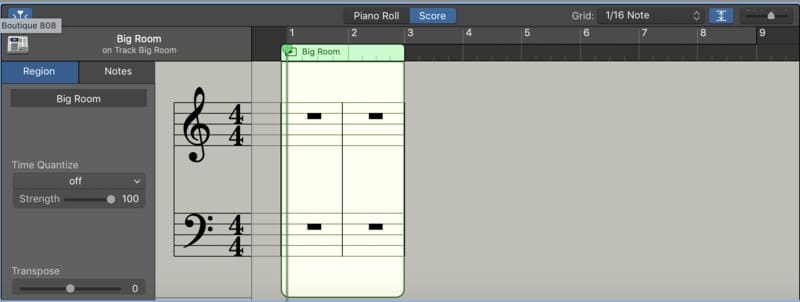
1) You can access the Score Editor simply by double-clicking on your music or "Midi Region."
ii) And and so go down into the Smart Controls, and click on the button that says "Score."
In this department, you tin edit the music through standard notation which I talked more almost in my guide on using the score editor. I actually utilise this every one time in a while, because I learned how to read music when I was a kid (although, I'm not nigh as good as I was as a kid).
I usually use information technology for creating bass lines. Sometimes, it's harder to hear if your bass line is off-key, and then yous tin either push it up a few octaves then you can hear information technology or, you can look at the standard notation to effigy out if the music is off-key or not.
Naming Your Tracks
If you want to name your runway, use the "Secondary Click" function ("right-click," and that'll bring up your options where you can see where it says, "Rename Runway."
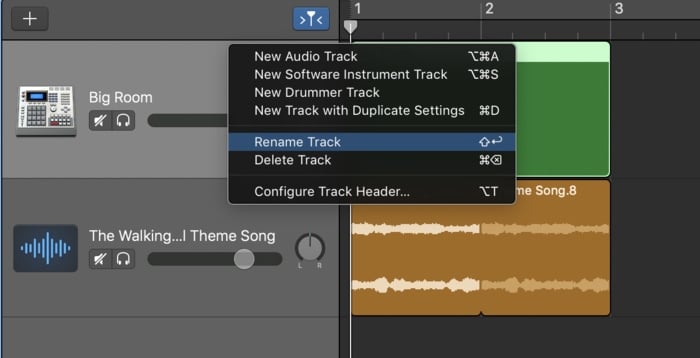
You lot can do the very aforementioned thing to the actual MIDI Region.
This seems like an obvious one considering it is. If you lot're going to be making music in a DAW, naming each track region will save you a ton of time, running through each one, trying to figure out which 1 is the kick and which one is the snare.
Reordering Tracks Through Drag and Drop
By clicking on and dragging the "Track Headers," Garageband users can actually easily move each software musical instrument rail to and from wherever they want.
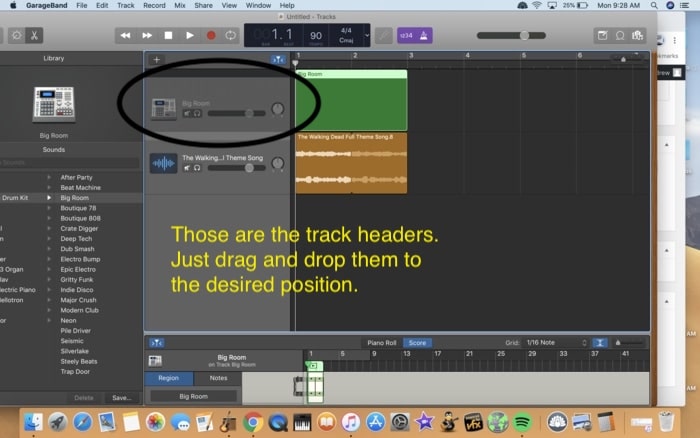
For case, grouping the guitars together, or the kick and bassline. You lot don't have to manually move the MIDI Region either; it will move with the Runway Header.
Time Quantizing
As you'd know if you've read my piano curlicue guide, rather than dragging and dropping each note and so information technology falls exactly on the filigree-lines in the Piano Gyre, which is normally what I would practise, y'all can use the Time Quantize function downwards in the DAW's Smart Controls.
For case, if you've recorded music with a MIDI Keyboard, and some of the notes are offbeat, using the Time Quantizing part will bring each note to where it needs to exist, rather than doing information technology all manually (more time quantizing tips in my guide).
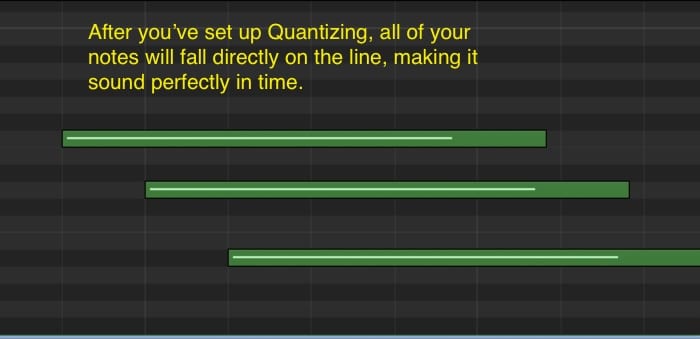
1) Beginning things offset, in the Software Instrument track, choose the choice "Region," rather than "Notes," in the Smart Controls.
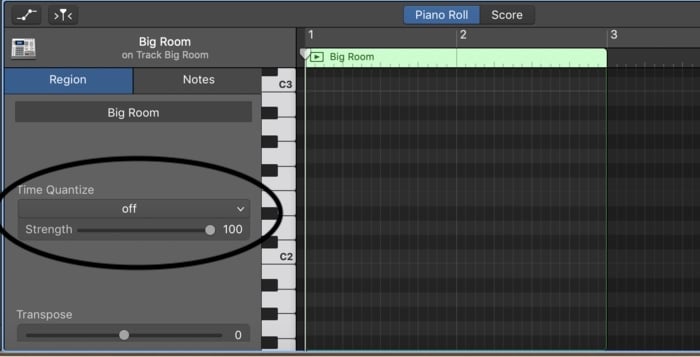
2) In your Smart Controls, underneath the setting, "Time Quantize," select i/8 Notation, and keep your Quantizing strength at around '75 to 100.' This should suck in all of the notes accordingly.
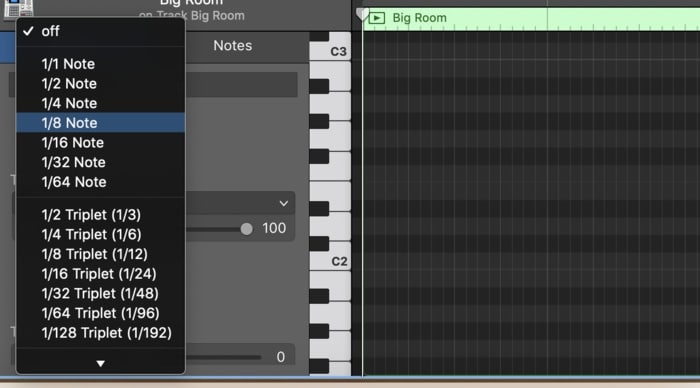
Obviously, there are more Timing settings i tin employ, just this is as far every bit I've ever used the quantizing function.
Some people argue against the use of Fourth dimension Quantizing, accusing the do of robbing the music of its "soul." The statement goes that there are idiosyncrasies and personality traits eliminated from the music through the quantization exercise.
For instance, when playing a guitar riff, if something is slightly off-fundamental or non in proper time, the inaccuracy and "incorrectness" of the note may precisely be, the exact thing that gives information technology its unique season.
The Blues Calibration, probably i of the well-nigh used scales in guitar playing, is the epitome of this. The Dejection Scale isn't classically "correct," due to its flattened 5th in relation to the minor pentatonic scale, or flattened third in relation to the major pentatonic.
How to Select and De-Select Options Way Faster
This is some other one that I just came across. Rather than manually selecting, say, for example, the "Mute" button on a agglomeration of tracks, and having to go through each i individually, there is a way of hitting all of them at in one case.
For case, if I want to hitting the "Mute" button on 10 of my 20 Software Instrument tracks, I'll hover my cursor over the "Mute" push button, and then click the rail-pad and concur information technology while I drag the cursor down the screen. This will hit every "Mute" push on the mode down.
It'southward the same practice for turning them off.
Conclusion
That's all for now. I hope this helped you lot out. Exist a trooper and share information technology on social media.
Source: https://producersociety.com/editing-tips-garageband/
0 Response to "How To Merge Tracks In Garageband"
Post a Comment